
What is happening
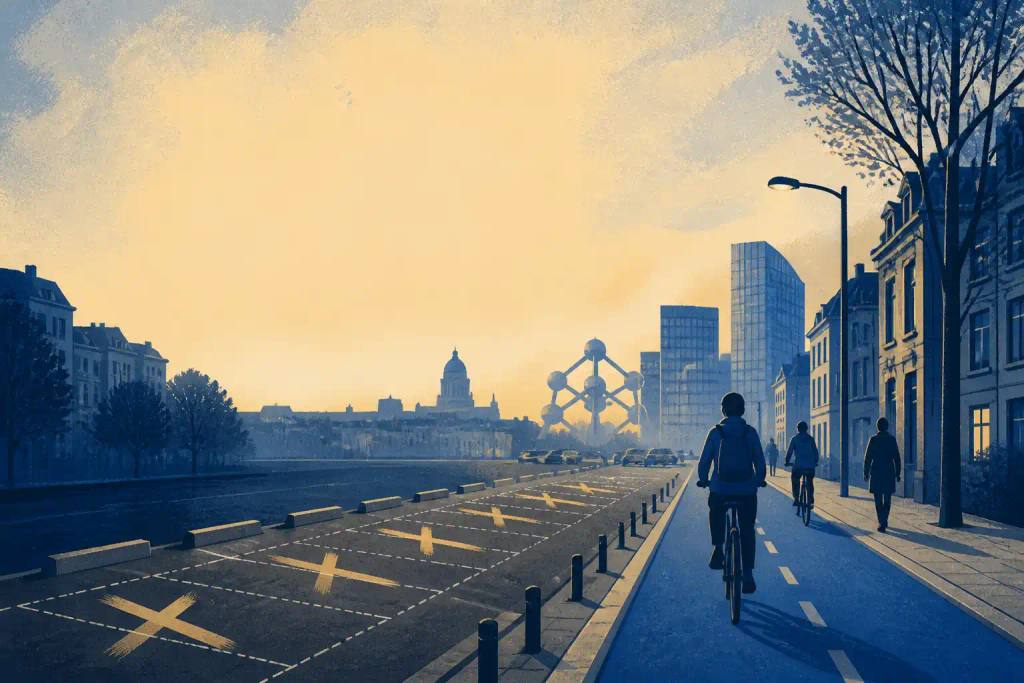
The Brussels municipality of Jette is concerned about the recent removal of more than one hundred parking spaces in Serkeynstraat. This measure is a direct result of the construction of a new cycle highway in the district. Although Beliris, the public real estate manager active in Brussels, confirms that these parking spaces are disappearing, they state that the affected spaces were considered superfluous. The local concern focuses on the impact on liveability and accessibility for residents and traders.
Impact of parking reductions in Jette
The construction of cycle highways is an important part of the sustainable mobility policy in the Brussels-Capital Region. However, its implementation sometimes entails side effects, such as the reduction in the number of available parking spaces. This leads to discussions about the balance between promoting cycling and providing sufficient parking facilities for cars, especially in densely populated urban areas like Jette. Residents express their dissatisfaction with the loss of these parking facilities and the possible consequences for their daily lives.
Background
The debate about parking spaces versus cycling infrastructure is not new in Brussels. For years, the Region has been trying to make mobility more sustainable by creating more space for active modes of transport such as cycling. This includes the construction of kilometers of cycle paths and cycle highways. Projects like this cycle highway in Jette are part of a broader vision to make Brussels more bicycle-friendly and reduce car dependency. The municipality of Jette itself, like many other Brussels municipalities, also has its own mobility plan in which these trade-offs are made.
Serkeynstraat in Jette has to contend with more than 100 fewer parking spaces due to the construction of a new cycle highway. Beliris confirms this, but argues that the spaces were redundant. (Bruzz)
The financing and coordination of such infrastructure projects often fall under the responsibility of Beliris, a partnership between the federal state and the Brussels-Capital Region. They are involved in various urban development projects and mobility works in the capital. Their role is crucial in translating policy visions into concrete projects on the ground, although this sometimes leads to tensions with local interests.
What this means for Belgium
Although this specific incident takes place in Jette, the problem is broader and representative of the challenges facing many Belgian cities. Governments, both federal, regional, and local, are striving for a transition to more sustainable mobility, which often goes hand in hand with the redistribution of public space. This means less space for cars and more for cyclists, pedestrians, and public transport. This shift, although necessary for climate goals and liveability, regularly encounters resistance from citizens who depend on their cars and the associated parking facilities. Finding a balanced approach that takes into account the needs of all road users remains a complex task for city administrations, such as in Jette and other Belgian cities.
The issue in Jette could set a precedent for future projects where the construction of cycling infrastructure in Belgium comes at the expense of parking spaces. It highlights the need for thorough communication and resident participation in such far-reaching changes to public space. The Brussels-Capital Region and the city of Antwerp are examples of regions where these types of mobility decisions have a major impact on the daily routine of residents.
